From the Desk of Senator Drey
Two weeks down in the Iowa Senate, and we’re just getting started!
This week, Veterans Day on the Hill brought the Iowa Capitol Rotunda to life as veterans, families, and service organizations showed up and spoke plainly about what still needs fixing. Visitors from across the state wore stickers reading “Vote YES on HF 1000,” calling for passage of a bill that would help Veterans Service Organizations hire and retain trained staff to assist veterans with their benefits claims. These benefits are promises already made, and access to them shouldn’t depend on how long someone can wait or how much red tape they can navigate.
I’m a proud member of the American Legion Auxiliary (like my mom and my grandma before her!), and I deeply appreciate the work they do every day to support our veterans and their families.
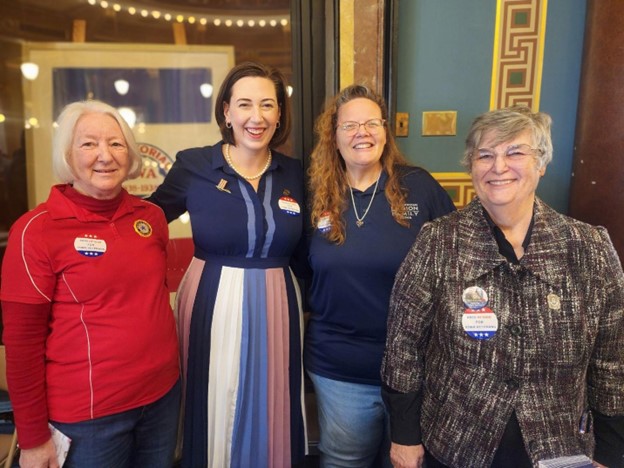
From left to right: American Legion Auxiliary members Jackie Peters (Woodward), Senator Drey, Becky Teed (Colfax), and Ann Crawford (Onawa) during a visit on Veterans Day at the Capitol.
Meet my clerk!
Fun fact: during the legislative session, a senator’s days in Des Moines are BUSY. To help manage everything and make sure we’re keeping up with our responsibilities to our constituents, each Iowa State Senator works with a legislative clerk. Clerks are trusted aides working with a senator on a whole bunch of issues. Clerks help senators manage their legislative portfolios – like committee and subcommittee assignments, bill filings, and amendments. They serve as administrative assistants, communicators, schedulers, sounding boards, and confidants. In short, clerks play an indispensable role in the Iowa Senate.
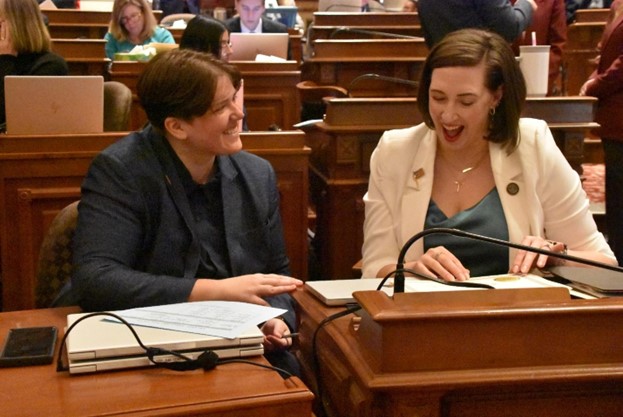
My clerk is Kira Barker! Kira lives in Des Moines and is a proud Lincoln High grad. We met during the campaign, when she teamed up with Senator Matt Blake and helped wrangle a busload of volunteers from Des Moines to Sioux City to knock doors with me the Saturday before the election. We spent the day out talking to voters together, and the rest is history!
This is Kira’s fourth year clerking at the Iowa Legislature, so she knows the Capitol inside and out—and more importantly, she knows how to keep things moving. I’m incredibly grateful to have her by my side this session helping me stay on track. An unexpected bonus: Kira laughs at most of my bad jokes.
ICYMI: My new education series is LIVE on TikTok!
If you’ve ever wondered why a bill never seemed to go anywhere, you’re not alone. That’s why I’m kicking off a new series on my social channels breaking down the basics of how the Iowa Legislature works.
Most people think bills rise or fall on the House or Senate floor. In Iowa, those decisions usually happen much earlier. In my first video, I explain how bills often live or die in a three-person subcommittee—sometimes without a vote and with only one chance for public input. You can watch the video on TikTok, on Facebook, or Instagram.
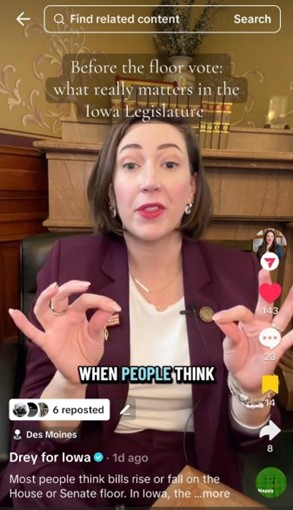
Stay tuned for more videos and be sure to follow along on all of my social media channels.
Join me this weekend: Education Forum & Siouxland Legislative Town Hall
Two important events are coming up this weekend. On Saturday, January 24, I’ll be joining the Sioux City Community School District’s Education Legislative Forum at 8:30 a.m. The forum will be held at the Educational Service Center, located at 627 4th Street in Sioux City.
Immediately after, I’ll join fellow Siouxland legislators for a Legislative Town Hall hosted by the League of Women Voters of Sioux City on Saturday, January 24, from 10:00–11:30 a.m. at the Sioux City Public Museum (607 4th Street).
The forum is open to the public and will be livestreamed on the League of Women Voters of Sioux City Facebook page. Questions may be submitted in advance through Facebook or by email at LWVSiouxCity@gmail.com. Additional town halls are scheduled with the same format for February 28 and March 28.
Big issues to keep an eye on
Every year, the Legislature deals with proposals on a really wide array of issues. We’re talking about everything from cancer prevention to jet ski regulations – truly, every issue you could imagine.
In those hundreds or thousands of policy ideas each year, there are always a couple of issues that stick out and occupy a lot of our time under the Golden Dome. K-12 school funding, for example, is a big point of conversation and debate every year. This year, the two big issues that legislators will be dealing with are property taxes and eminent domain.
We caught a glimpse of the property tax issue at the tail end of the 2025 legislative session. The massive, unwieldy proposal was introduced late in the session and didn’t move very fast or very far. But now the issue of property tax reform is back in a big way. Here’s the headline: we still have no idea what will be in the final proposal. The majority party currently has three separate and unique plans for property tax reform: one in the Senate, one in the House, and one from the governor.
So, while the final details are murky, what’s crystal clear is that the majority party’s inaction on real property tax relief – nearly a decade of nothing – has driven us to this inflection point. Senate Democrats are ready to work on property tax reform that creates permanent, sustainable relief for Iowans who need it. This should be a conversation and a process that happens out in the open, rather than behind closed doors, and brings everyone to the table. If we can create a simpler, more predictable system that encourages investment in the state and ensures local governments can continue to provide public safety and other essential services that residents want, you’ll see broad bipartisan support for property tax reform. But we can’t let “reform” become a code word for yet another giveaway to corporations or the wealthy and leaves working families and communities shortchanged.
The second major issue before the Legislature this year is even more contentious and fraught than property tax reform. Last year was the first time the issue of eminent domain for carbon capture pipelines had reached the Senate floor, after years of stonewalling from Senate Republican leadership. There were different proposals in the House and Senate, and, after weeks of fits and starts and several blow-ups on the Senate floor, one made it through both chambers and to the governor’s desk, where it was promptly vetoed.
This year, the issue is back in full force. The House introduced a bill in the first week, ran it through committee, and brought it to the floor for debate on Wednesday. (It passed 64-28.) Senate Republican Leader Mike Klimesh introduced a bill in the Senate (SF 2067), which is different than the House bill. It’s not at all clear at this point that Republicans in the House and Senate are any more aligned this year than they were last year, or whether any of these proposals has any real hope of advancing through both chambers.
If you feel passionately about these issues – or any issue – please don’t hesitate to reach out with your thoughts, comments, or concerns, both to me and to Senate Republicans, whose email addresses you can find here.
I’ll do my best to keep you updated as these ideas, and the hundreds of other policy proposals, move through the Iowa Senate this year.
Quick Updates
Iowa driver’s license renewal: Iowans wanting to schedule a time to renew their driver’s license or utilize other motor vehicle services can now find all locations in one place. A new system from the Iowa Department of Transportation combines all 18 walk-in locations and 79 county treasurers’ offices. The site allows users to navigate and find the best time and most convenient location to complete the transaction.
Land and Water Conservation Fund grants available: Iowa’s cities and counties can now apply for funding through the Land and Water Conservation Fund grant program, which provides financial support for outdoor recreation projects at the local level. The grant cycle is open through March 6, 2026. The program provides up to 50 percent cost share in the form of reimbursement grants, with annual assistance of up to $250,000 per proposal. For more information and to apply, visit Iowa DNR LWCF web page,
Deer donation program open year around: Hunters may sign up as a deer donor or recipient with the Iowa Deer Exchange at www.iowadnr.gov/deer.