From the Desk of Senator Drey
My first session starts Monday, and I am going in knowing that Iowans deserve better than what we’re getting. I’m also clear-eyed about what being in the minority party means.
We’ll be facing familiar challenges: rising costs for families, ongoing fights over property taxes, and continued debates about land use and eminent domain.
Water quality, public health, and public safety are also expected to take center stage. These aren’t abstract policy debates. They affect whether kids can safely drink from the tap, whether rural hospitals can keep their doors open, and whether families feel safe in their neighborhoods.
I am (perhaps naively) hopeful that some good can come and I will be doing all I can to hold Republicans accountable and bring constituents’ actual priorities to the Capitol (more on that below).
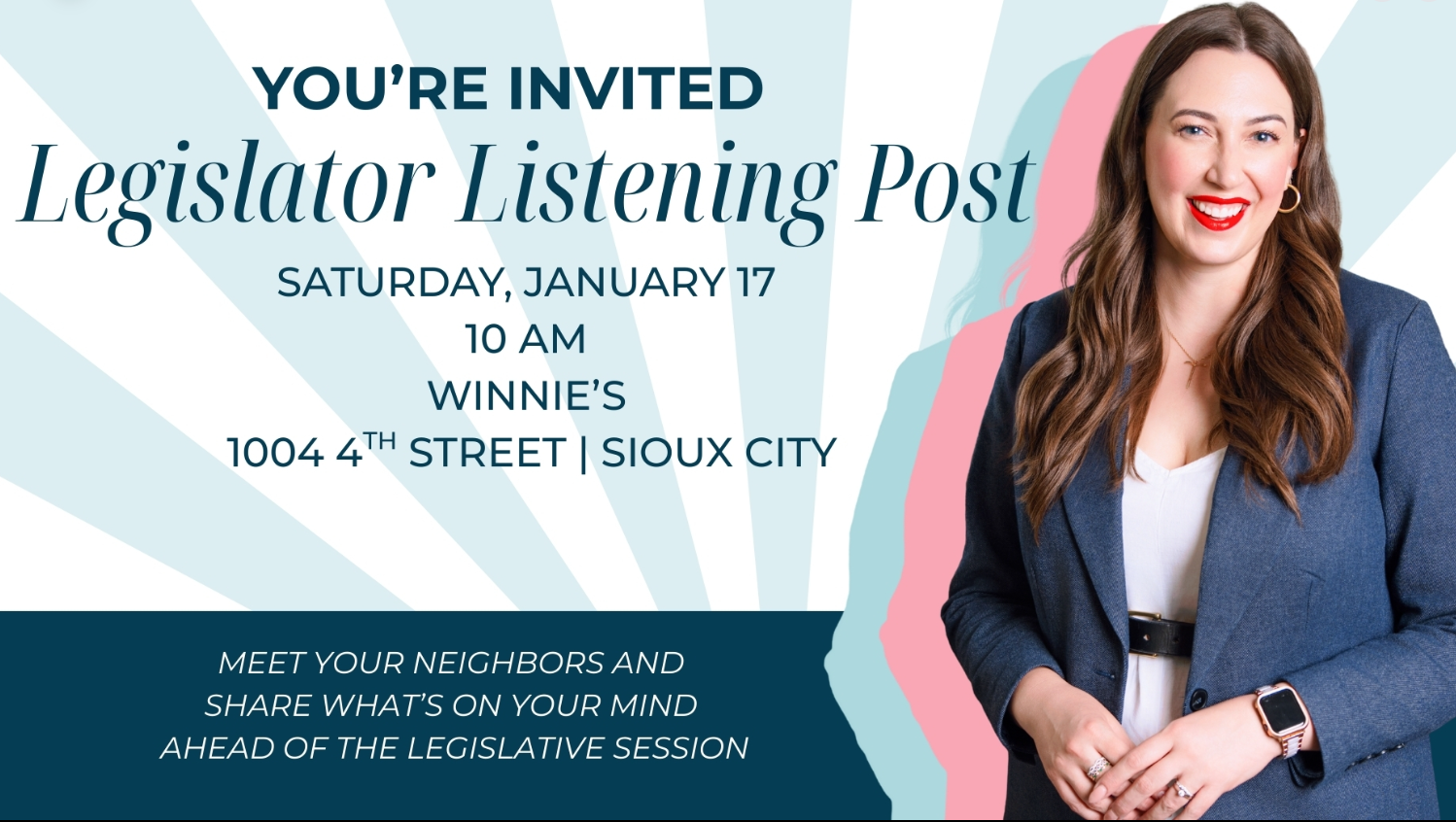
You can always reach me by responding to this email, or by phone at (712) 227-1707.
2026 Legislative Priorities Survey: Affordability and Public Education Lead the Way
In the last few weeks, nearly 800 of you responded to our 2026 legislative priorities survey, telling Senate Democrats about the issues most important to you and your families. Thank you so much for your feedback!
We’ll share more detailed information about your responses in the coming weeks, but I want to take a moment to look at your responses to two specific questions.
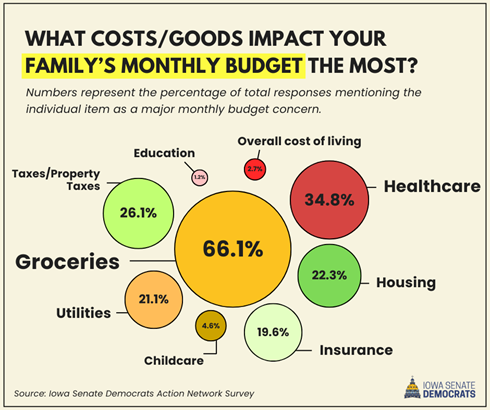
We know Iowans are feeling the squeeze as household budgets get tighter. That’s why we’ve made lowering costs and making life more affordable for working families our main priority going forward. So, we asked: What costs/goods impact your family’s monthly budget the most?
- The top answer, by far, was groceries. The rise in food prices is outpacing inflation, meaning your weekly grocery haul is more expensive. While grocery costs are generally more expensive across the board, many of you noted the uptick in meat prices as particularly worrisome.
- The second highest answer was healthcare. Your examples included prescription drug costs, nursing facility care for a loved one, provider shortages and unavailable services in your local area, limited reproductive healthcare access, and rising insurance costs.
- Respondents also talked about housing, utilities, property taxes, insurance, childcare, and education.
We asked: What could your state government do to make a positive impact on your community? Here are your top-line answers.
Invest in public education
- You overwhelmingly called for better funded public schools, voiced your opposition to private school vouchers, and talked about teacher pay with worries about brain drain.
Protect the water and the environment
- You see Iowa’s water quality as a top concern tied to long-term health and community well-being. Many of you wrote about active monitoring, enforcement, and polluter accountability that goes beyond symbolic measures.
Make life affordable
- Respondents included cost-of-living pressures like housing, healthcare, childcare, utilities, and groceries, as well as concerns about burdensome restrictions for folks on SNAP/WIC or other assistance programs.
Expand healthcare access
- Many of you wrote about your worries about potential rural hospital closures, long waits, and rising insurance costs. Respondents are especially concerned about provider shortages.
Ensure fair governance and rights
- Survey respondents want a government that works for people, not corporations. You talked about fair taxation, limits on corporate influence, and protecting individual rights.
A Billion-Dollar Deficit with No End in Sight
In less than a week, the Iowa Legislature will reconvene in Des Moines to begin the 2026 legislative session. Lawmakers will discuss and debate all manner of issues relevant to making life more affordable for Iowa’s working families, including property tax relief, housing Iowans can afford, reliable childcare options, public education funding, and much more. A critical factor in all those discussions, looming over everything we do this year, is the condition of the state’s budget.
Last session, Republican lawmakers passed a budget for Fiscal Year 2026 (the current fiscal year, running from July 1, 2025, through June 30, 2026) that spent $9.425 billion. However, the latest estimates from the state’s Revenue Estimating Conference (REC) (which met on Dec. 11, 2025) project state revenues at $8.158 billion.
This means that, for Fiscal Year 2026, Iowa will spend $1.26 billion MORE than we take in, creating a massive budget deficit hole. In order to cover that hole, Republican lawmakers will need to transfer $633.4 million from the Taxpayer Relief Fund and $633.4 million from other one-time funds, breaking the majority party’s own rules about spending one-time money to cover ongoing expenses and spending more than the state takes in.
Unfortunately, we also know that this budget mismanagement is not a one-time blip. Five-year projections obtained from Gov. Reynolds in early 2025 show that the majority party plans to run these budget deficits through at least FY30. We also know that the governor’s estimates in her five-year projections have been off by roughly $1.36 BILLION. As Jon Muller, a former revenue forecaster for the REC, put it, “Iowa Republicans appear to be budgeting on pure hope.”
So, why should you care what the state’s budget looks like? Well, beneath all the numbers, what the state budget really represents is lawmakers’ priorities – toward which policy issues the Legislature chooses to allocate taxpayer funds. Simply put, it’s how we put your tax dollars to work. This budget, designed and implemented by the majority party, is not working for you.
Instead of prioritizing the needs of Iowa’s working families – like housing, childcare, public education, etc. – the Republican budget prioritizes corporations and the very wealthy. Here’s a perfect example: according to the REC’s latest projections, between Fiscal Year 2024 and Fiscal Year 2027, the income tax corporations pay will have dropped by nearly $200 million while, during the same period, sales tax collections will have increased by over $350 million. In other words, you’re paying more for groceries and other goods while big corporations get a tax break.
For nearly a decade, Republican lawmakers have been overpromising on economic growth and underdelivering for Iowans. It’s time for a hard reset on the Legislature’s priorities, and time for Iowa’s working families to get a state budget that works for them.
Welcome, Senator-Elect Hardman!
Our caucus is growing!
On December 30, Renee Hardman, a Democrat from West Des Moines, won the special election in Senate District 16 with 71% of the vote! Renee is a nonprofit and business leader with deep roots in West Des Moines. She is a former member of the West Des Moines City Council and the current CEO of Lutheran Services in Iowa. Renee’s election is also a historic moment – she will become the first Black woman to serve in the Iowa Senate. I am honored to serve alongside, and learn from, Renee.
Welcome to the team, Senator-elect Hardman!
This Week Around the District