From the Desk of Senator Drey

Standing with Iowa’s Veterans
On Thursday in Sioux City, our community gathered to welcome home soldiers from the 2nd Brigade Combat Team, 34th Infantry Division, who recently returned from deployment in the Middle East as part of Operation Inherent Resolve.
These servicemen and servicewomen, based in Sioux City, Des Moines, and Cedar Rapids, spent months working alongside coalition and regional partners to reduce the capabilities of ISIS in Iraq and Syria and help make the region safer. Earlier this month, the first group of soldiers — about 50 members of the brigade — returned to Sioux City as part of their phased return home.
Moments like this are a powerful reminder that supporting our veterans doesn’t end when their deployment does. It means continuing to show up — in our communities and in our policies.
That’s why earlier this session I introduced SF 2246, legislation to continue funding programs that help Iowa veterans achieve homeownership. These programs have helped veterans and their families put down roots, build stability, and access housing opportunities that might otherwise be out of reach.
The strong demand for these programs shows just how important they are for veterans across our state. As more veterans take advantage of these opportunities, the funding is being utilized quickly — and that means we need to make sure the program can continue to meet that need.
For many veterans, the transition back to civilian life comes with real challenges, including finding safe, affordable housing. Programs like this are one way Iowa can keep faith with the people who served our country.
As we welcome these soldiers home to Sioux City, I hope we can also recommit ourselves to making sure the support they’ve earned remains a priority in our state.
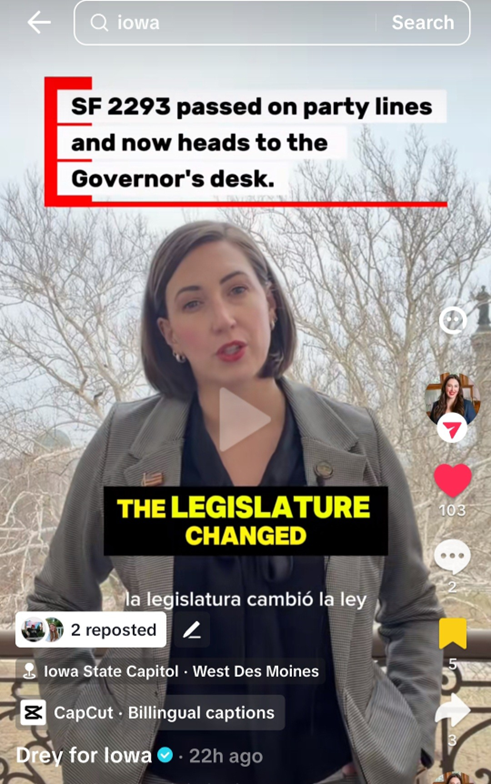
Over the past few weeks, thousands of Iowans have been following along with my updates from the Capitol on Facebook, Instagram, and TikTok. I started posting those videos to explain what’s happening in the Iowa Senate in plain language, and the response has been incredible. More importantly, the conversations remind me how many people across Iowa are paying attention to what’s happening at the Statehouse.
This week I shared a video about something that’s been on my mind a lot lately: the idea that those closest to the pain are often closest to the solution.
Since I announced my cancer diagnosis, many of my colleagues have shown real care and concern. I’m grateful for that. Moments like that remind you how important it is for people in positions of power to listen to the folks living with the consequences of their decisions.
But when I look at what the Iowa Senate majority has been doing this week, I worry they’re losing sight of that.
City councils across Iowa passed civil rights protections because they saw a need in their communities. Instead of listening, the majority party stepped in and said they knew better.
Historians and educators warned lawmakers not to weaken access to Iowa’s historical archives. Instead, the legislature changed the law so the state could walk away from that commitment while a lawsuit is still ongoing.
And Iowans have been crystal clear about the challenges they’re facing every day: finding childcare, stagnant wages, access to cancer screenings and prevention.
Yet those priorities still aren’t at the center of the work happening at the Capitol.
When the people living the consequences tell you what’s wrong, you can listen… or you can push ahead anyway.
Right now, too often at the Capitol, power is speaking louder than pain.
🎥 Watch the full video update here.
You can also:
Near the cliff’s edge

One of the most, if not the most, important functions of the legislature is to pass a budget, and each year, the legislature uses information provided by the state’s Revenue Estimating Conference (REC) to help build that budget.
REC meets three times per year – in March, October, and December – and lawmakers must use the lower estimates from either the December or March meeting when crafting the budget. Using the lower set of estimates is meant as a safeguard against overspending. For example, if the December estimates project $8 billion in revenue but the March estimates project $7 billion, it makes more sense to use the March numbers as a foundation so we don’t spend a billion dollars we don’t have.
At least, that’s how it works in theory.
In the 2025 legislative session, Republican lawmakers passed a budget that spent significantly more money than the state took in, creating a $1.26 billion deficit hole (which has since grown to $1.3 billion with the latest REC numbers). This happened despite REC estimates projecting a substantial drop in revenues.
The governor and Republican lawmakers are using one-time funds, like the Taxpayer Relief Fund (TRF) and surplus carryover, to cover the ongoing expenses and fill the budget hole. But those one-time reserve funds are draining much quicker than they anticipated because their original projections have been off by about $1.44 billion, meaning they’ve needed to transfer more money from the TRF than anticipated.
And the slope gets even more slippery because Republican lawmakers are planning another billion-dollar deficit this year. In fact, according to the governor’s five-year projections, the majority party plans on running budget deficits through at least 2030. This means more transfers from the reserves and fewer reserve funds to help cushion the lack of revenue growth.
Beyond the dollars and cents of all of this, why should you care about the state’s budget situation or the information that comes from REC?
For starters, the Republican budget is not working for you. The main beneficiaries of their budget priorities are corporations and the very wealthy. Between Fiscal Year 2024 and the current projections for Fiscal Year 2027, the income tax paid by corporations will have dropped by over $235 million while, during the same period, sales tax collections will have increased by over $395 million. That means you’re paying more for groceries and other household needs while big corporations are getting a tax break.
The budget situation also looms large over everything the legislature is doing this year, which has a direct impact on the issues Iowans care about. Take school funding, for example. The majority party is no stranger to underfunding our schools, but this year’s meager increase is almost certainly affected by budget constraints. Or take SF 2464, which would increase taxes on health insurance companies in an effort to drum up some of the majority party’s missing revenue growth – the tax hike would be passed along to Iowans in the form of higher monthly health insurance costs. So, Republican lawmakers get some money to start filling in their deficit hole, and you get more expensive health insurance premiums.
You should also care because this budget mess affects how the majority party plans to govern in the not-so-distant future. Senate Republicans introduced a bill that would let them take their ball and go home when they can’t pass a budget – like when negotiations get a little tougher under a divided government with a Democratic governor.
If we’re not careful, the majority party will march us right off the fiscal cliff.
Quick Updates
Movement on property tax reform: SSB 3001, the Senate Republicans’ property tax proposal, advanced through the Senate Ways & Means Committee this week with as amended. The issue is still a work in progress, and we still don’t know what will be in the final bill we vote on by the end of the legislative session.
Opioid Crisis Grants: The application period is now live for grants designed to help communities across the state respond to the opioid crisis. The Attorney General’s office currently expects approximately $20 million to be available by June 30, 2030, for distribution. Organizations who wish to apply can do so here. Applications will be reviewed on a rolling basis, and projects of all size and scope are encouraged to apply. Projects funded by the Attorney General’s office must comply with the requirements of the National Opioids Settlement and the Iowa Opioid Allocation Memorandum of Understanding.
Virtual Field Day: Iowa Learning Farms, in partnership with the Iowa Nutrient Research Center, will host a virtual field day on Thursday, March 26, at 1 p.m. In this innovative project, funded in part by the Iowa Nutrient Research Center, the focus is on how restoring wetlands, which are crucial to reducing nitrogen loads from agricultural fields, impacts the broader food web to maximize additional ecological benefits. Visit the Iowa Learning farms website to participate in the live virtual field day.
Honoring Major Jeffrey O’Brien: Last week we learned that another Iowa soldier, Major Jeffrey O’Brien of Waukee, was killed in action in Kuwait. Major O’Brien was a husband and father of three. I am profoundly grateful for his service and ask that we all keep the O’Brien family in our thoughts as they grieve this terrible loss.
$5M for more Continuum of Care grants: This week, the governor announced $5.2 million in Continuum of Care grants for childcare and preschool expansions. This is the second round of Continuum of Care awards. The program is meant to help fill gaps in full-day care for Iowa kids. You can find more information about the grants here.
Fighting to improve Iowa’s water quality: This week, the Senate debated HF 2215, a bill relating to the Department of Natural Resources. Senate Democrats introduced an amendment that would have given the department more teeth to fight against polluters, in the hopes of curbing Iowa’s ongoing water quality issues. Ultimately, the amendment was ruled not germane to the bill and did not move forward.